 New Giant Figure Discovered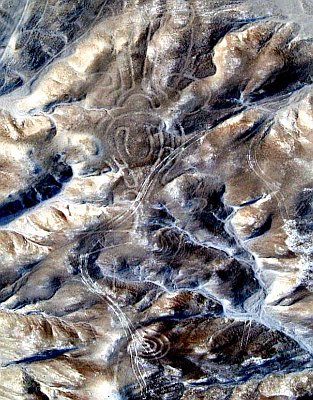
A new giant picture on the Nazca Plateau in Peru, which is famous for giant patterns that can be seen from the air, has been discovered by a team of Japanese researchers.
The image is 210 feet long, and appears to be an animal with horns, somewhat resembling (of all things) a lobster. It is thought to have been drawn as a symbol of hopes for good crops, but there are no similar patterns elsewhere, and the type of the animal remains unclear. The discovery marks the first time since the 1980s that a picture other than a geometrical pattern has been found on the Nazca Plateau.
The picture was found by a team of researchers including Masato Sakai, an associate professor at Yamagata University, after they analyzed images from a U.S. commercial satellite. They confirmed it was a previously undiscovered picture in a local survey in March this year. It is located at the south of the Nazca Plateau, and apparently went undiscovered since few tourist planes pass over the area.
There is evidence that vehicles had driven in the area, and part of the picture is destroyed.
Two parts of the picture, that appear to be horns, bear close resemblance to those that appear on earthenware dating from 100 B.C. to A.D. 600, during the time when the Nazca kingdom flourished, and it is thought that they relate to fertility rites.
The research team will use images from the advanced land-observing satellite "Daichi," which was launched by the Japan Aerospace Exploration Agency in January this year, to create a distribution map of images on the earth that can be seen from the air.
For years people have been making theories
about who made the giant figures, how they were made and especially why they were made. A review of these theories
follows.
Perhaps even more interesting than the figures of animals and the zig-zag lines is one unusual image known as "the mandala." This image is extremely remote and sits atop an arid mountain plateau.
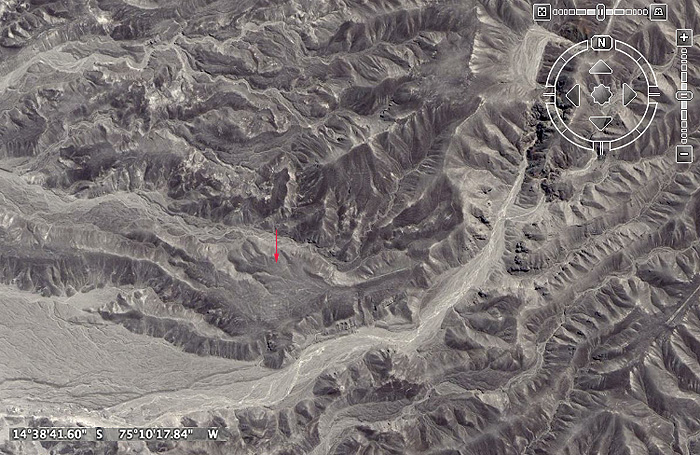
The image appears to have been carved with exceptional precision. A large square measures 180 feet across while an inner circle spans the same diameter. Several smaller squares, about 20 feet wide, appear to have been etched in the landscape along with an assortment of stategically placed holes.
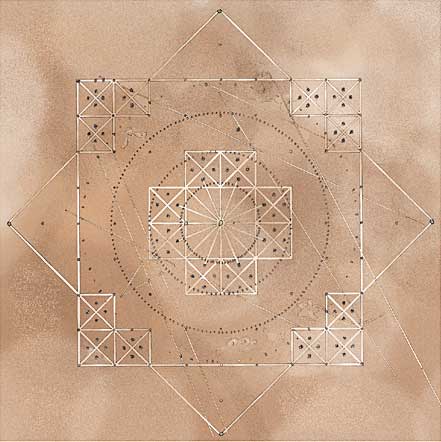 Gilbert de Jong -- A Nazcan Zodiac
Gilbert de Jong actually visited and meticulously surveyed Nazca, measuring and plotting the features with GPS. He was especially interested in the so-called "mandala" figure. This figure, a huge circle inside of a square, appeared to remind him of a zodiac map. This was further supported by the image if a snake-like creature, positioned at one point where de Jong expected to find the symbol for "Aries."
The absense of any other zodiac signs is puzzling. Also, no one has yet figured out the significance of the many holes and pits that are an integral part of the structure.
Gilbert de Jong believes that the interpretation of the many other animal figures is likely to be different representations for constellations by an ancient culture.
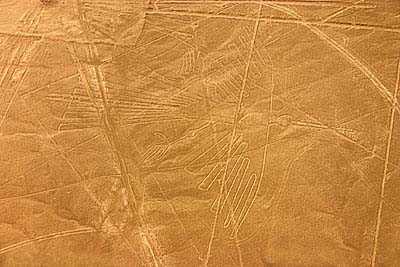 Left:
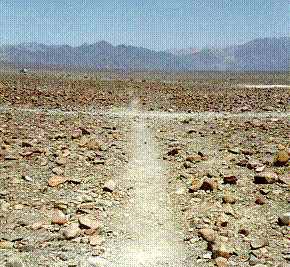
Left: The images are formed by removing randomly scattered stones from the path, exposing the hard packed sand of the desert floor. The paths have been further compacted by footsteps as the ancients appear to have walked along the paths in some ritualistic ceremonies. This is also how the recrangles are made, but on a much larger scale.
Other theories about the Nazca Lines & FiguresErich von Daniken -- Cargo-CultErich von Daniken's theory is the most famous theory, but it is also the most mis-represented. He never said that the images were made by aliens. Von Daniken believed the line drawings were made by ordinary indians of the region following their encounters with an extraterrestrial race, who used the Nasca plains as a landing strip, or airport, during their expedition to Earth.
It's interesting to see how dated von Daniken's theory is when you realize that he interpreted the trapazoid and rectangular shapes as being caused by repeated blasts from alien rocket engines. He envisioned the debris would be blown away, leaving the clear desert floor. Today, we are likely to see rocket and jet technology as somewhat primitive. UFO's seem to have more advanced antigravity propulsion systems, capable of vertical take off, and leaving no blast effect.
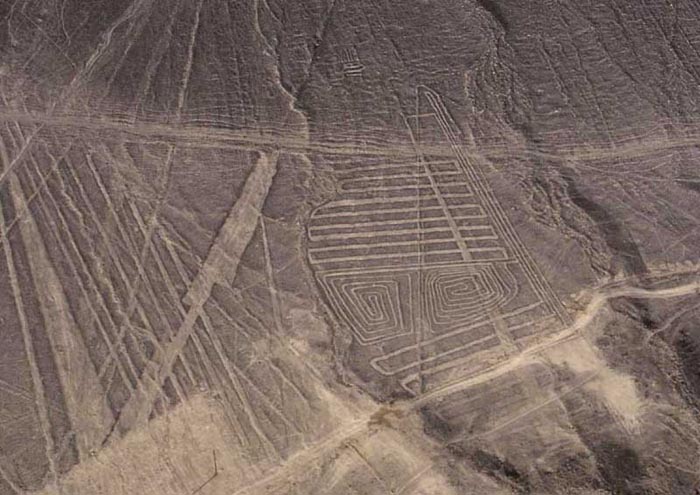 Alan F. Alford -- Negroid Slaves
According to Alford, the Tihuanaco Culture had a large population of Negro slaves that were forced to make these designs under harsh conditions. After a revolution the Negroid population rebelled and destroyed some of the figures, making zigzag and meandering lines to obliterate them. Later the Negroid population migrated North and founded Chavin and the Olmec culture.
One must wonder why, if it was so difficult to make the original designs, these people would invest the time and effort to obliterate and cover them with equally difficult patterns.
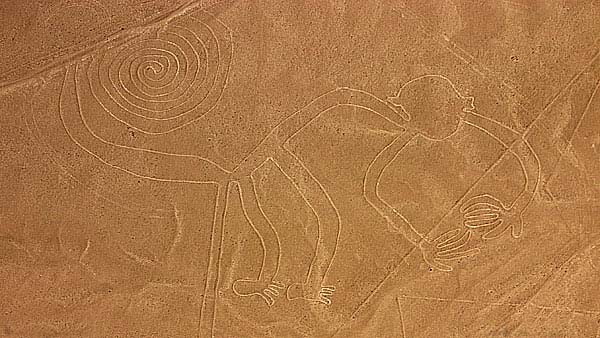 Robert Bast -- A memory of the Deluge
Robert Bast from Australia has a very interesting theory. All these animal, plant and human-shaped figures are lying together on the ground, as if they were corpses remaining after some catastrophic flood. So it could be a memorial place of the "big flood." Many cultures in the world have deluge-myths. But one has to question why these animals, of all the known species that exist, were selected.
Robin Edgar -- Solar EclipsesRobin Edgar from Canada proposes that the Nazca figures were inspired by, and intended to be seen by, the (so-called) "Eye of God" that is manifested during total solar eclipses. An extraordinary series of solar eclipses coincided with the construction of the Nasca lines. Some Lines are aligned with the winter solstice which is often considered as the "death" and "rebirth" of the Sun God.
 Maria Reiche -- Astronomical Theory
Maria Reiche, the most famous Nazca-Researcher, prefers the astronomical theory. She theorizes that the lines could point in the direction of the rising of important stars or planets and events like sun solstices. Formations like the spider and the monkey could show star constellations like Orion and Ursa Mayor.
Since constellations are constantly changing their position in the sky, because of the precession, Reiche suggests that these alignments could be very old. This would explain why they do not align today and could be a marker of when they were created.
The age of the lines and figures is difficult to determine. They could be extremely old but restored by progressive civilizations over thousands of years. Examination of the desert floor suggests that this may be the case; however, archaeological evidence points to a more recent construction.
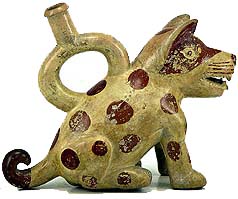
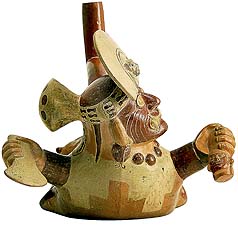
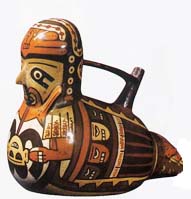
Clay pottery and debris has been found along the lines, suggesting food or water was carried to the location either for its construction, ceremonial use, or perhaps both. Radiocarbon dates, based on ceramic and wood remains which were left at the Lines by the Nazcan people has been dated to an era between 300 BC and AD 800. The pottery shards of the style and type of the Nazca culture, further establishing these recent dates as most probable.
Bray Warwick also tried to determine the site's age by examining the stones along the figures. In the heat, the upper exposed side of the stones form a patina of manganese oxide, traces of iron and clay minerals. Below, the stones are covered with mushrooms, lichens and cyanobacterias. Stones in proximity to the lines were used to analyze this organic matter by C-14-Method. Analysis revealed values between 190 B.C. and 600 A.D.
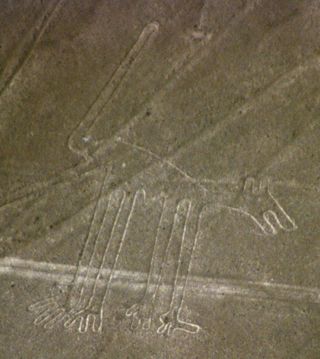
The second piece of evidence is the alleged resemblance of the Nazca geoglyphs to certain features found on Nazcan pottery. This is an important issue because it potentially offers proof that the Nazcans had either designed the images or at least viewed them from the air, since the exact shapes could not otherwise have been known.
National Geographic Society weighs in on the controversy:In 1968, a study by the National Geographic Society determined that, while some of the Nazca lines did point to the positions of the Sun, Moon and certain stars two thousand years ago, it was no more than could be expected by mere chance. In 1973, Dr. Gerald Hawkins studied 186 lines with a computer program and found that only 20 per cent had any astronomical orientation -- again no more than by pure chance. In 1982, Anthony Aveni obtained similar results. In 1980, Georg Petersen pointed out that Reiche's theory did not explain the different lengths and widths of the lines.
Professor Gerald Hawkins went to Nazca initially to prove the astronomical theory of Maria Reiche. He made a new, more precise survey and analyzed the course of important stars by using new computer software. This software included the star positions for the last 6900 years. After weeks of work they were very disappointed and stated, "We didn't find any astronomical context."
Johan Reinhard has recently noted that the surrounding mountains provided a ready-made and much more effective mechanism for the Nazcans to use as a solar calendar. Native Americans have long used mountain peaks and geometric shapes on rock cliffs to sight the rising Sun and Moon alignments, necessary for determining the best time for planting crops and annual migrations. With all the mountains and peaks in Peru, using these lines for that purpose would have been quite superfluous.
[Maria Reiche, the German mathematician and archaeologist most famous for her research into the enigmatic figures of Nazca, died in 1998 at the age of 95. She is buried in the arid valley she loved so well.]
Jim Woodmann -- The Balloon TheoryJim Woodmann conducted an experiment making a balloon of fine Peruvian cotton, and a reed basket made by Aymara-Indians. This flying object was called "The Condor." He believed that this method was used by the ancients to direct the construction of the giant figures. He did not explain how such directions would be communicated from the balloon to the ground crew. Hot air from a fire was brought into the balloon and it began to rise uncontrolled. The two pilots narrowly escaped injury before the balloon flew away.
Prof. Anthony Aveni -- Water-Cult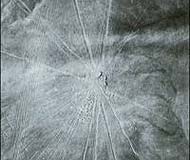
Anthony Aveni compares the Nazca lines with the ceque-lines [
right] in Cuzco. Those lines were made in connection with a calendar, water and mountain deities. In this way the Nazca Indians celebrated a water-cult ritual. The figures and lines were used as paths for ceremonial dances.
Michael Coe -- Ceremonial PlacesMichael Coe also believes the Lines are sacred paths to walk during specific ceremonial rites. But primary the lines was a offering for elders, heaven- and mountain-deities who spent water for fields.
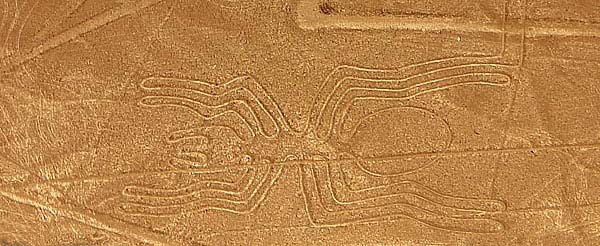 Georg A. von Breunig -- Sport stadion
Breunig has the very interesting idea that Nazca was used for sprinting to honor especial gods or ritual competitions. The area was a kind of "Olympia" where athleted would be made to run along the various shaped tracks. This theory was also supported by the famous professor Hoimar von Ditfurth.
The Code of Carl Munck: The Ancient Geomatria of NumbersThis theory states that the ancient sites around the world are very precisely positioned on a global coordinate system in relation to the position of the Great Pyramid at Giza. The positions of the sites are given in the geometry of their construction. A very ancient system of numbers was used in the system, which we will call "Gematria." Gematrian" numbers are found in ancient myths and religions, including the Bible. Gematrian numbers were used in systems of weights and measures by ancient peoples, including the Greeks, the Egyptians, the Persians, the Babylonians and the Romans.
The Code system uses mathematical constants, such as
pi and the radian. The system also uses conventions that are still in use, such as the 360 degree circle, 60 minute degree, 60 second minute, the base-ten numbering system, the 12-inch foot, and the 5280 foot mile. The ancient Mayans used Gematrian numbers in their very accurate timekeeping. The Nazca Line ground markings "locate themselves" on The Code Matrix System. This theory is part of a new science called Archaeocryptography.
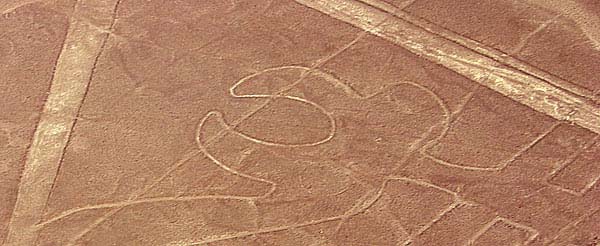
Hawkins and his group went to Nazca to prove the astronomical Theory of Maria Reiche. The made new and precise survey and analyzed the course of important stars by using new computer software. This Software included the star positions of the last 6900 years. After weeks of work they had very disappointed to say: We didn't find any astronomical context.
A similar theory is put forth by John D. Miller. He analyzed different buildings worldwide and found the value of 177 Feet in ancient buildings and old cathedrals. His theories are based on several holy numbers and units, so he believes that there is a deeper importance within these figures.
Dr. Zoltan Zelko -- MapThe Hungarian mathematician Dr. Zoltan Zelko analyzed the Nazca-line-system and compared with other ancient places in Peru. So he found out that Nazca could be a map of a 100 x 800 kilometer including region around the Titicaca-Lake.
Evan Hadingham -- HallucinogensEvan Hadingham proposed that the ancient Nazca priests used powerful hallucinogenic concoctions that made them adept at "out of body" experiences. He theorized that the priests, or shamans, were able to transform into spirits and fly above the land. To amuse them or possibly honor them, the giant line art was created.
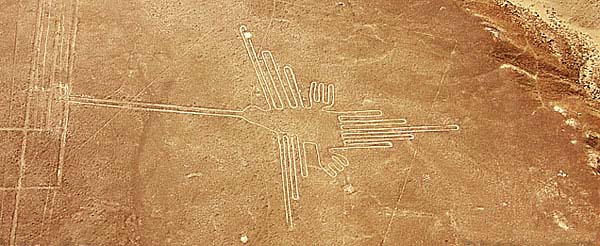


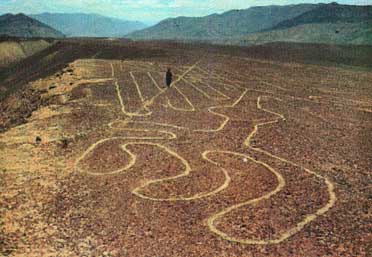 Albrecht Kottmann tried another approach to the Nazca-Mystery. He divided the figures into different parts and analyzed them in a geometrical way. So he divided a bird of 286 Meter length into 22 Parts. So he found that the head takes two parts, the neck five parts, the body three parts and the other twelve parts for the beak. The proportion between the beak and the rest is 6:5. Kottmann believes the geometric signs are a picture writing system with giant and small letters.


